Verrix 2021

Five kings fight over Britain,and nobody is watching Rome.

Worker placement on a map with direct conflict: you develop, trade, raid and declare battle. The game that opened the Dawn Town Games catalogue, after five years of playtesting at fairs.

How to play

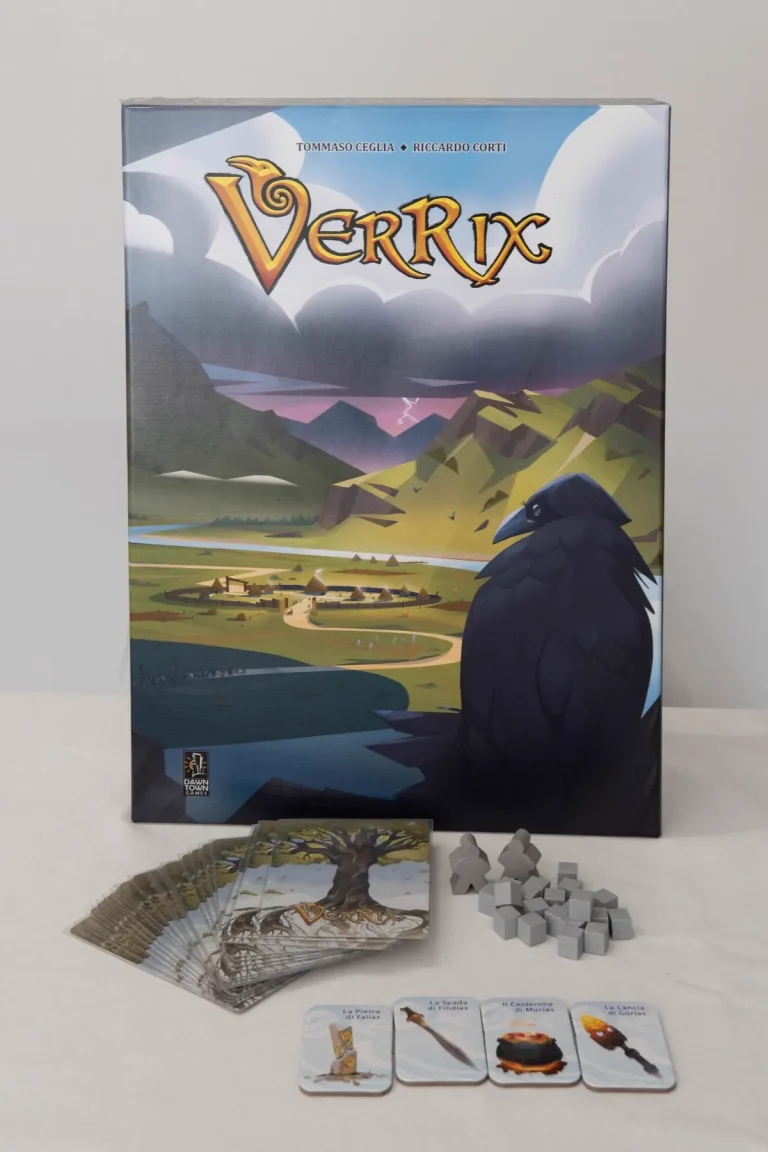
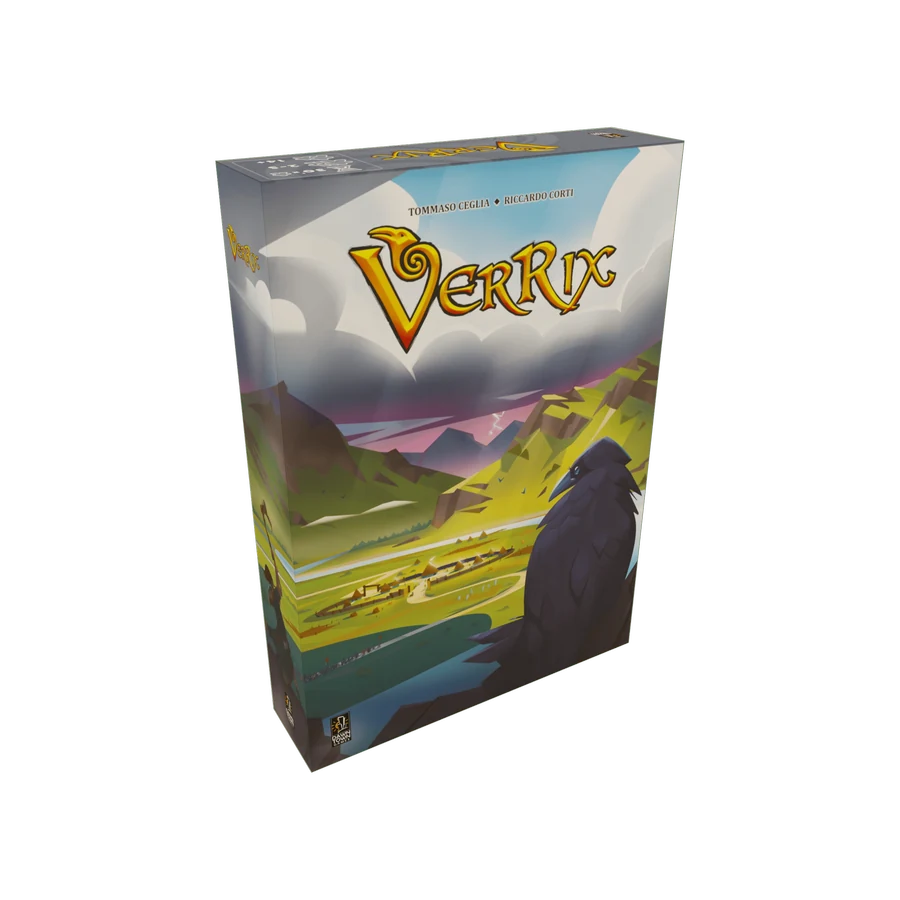
The box of Verrix

Who sits down, and for how long

  • 2–5players
  • 30′per player
  • 14+years
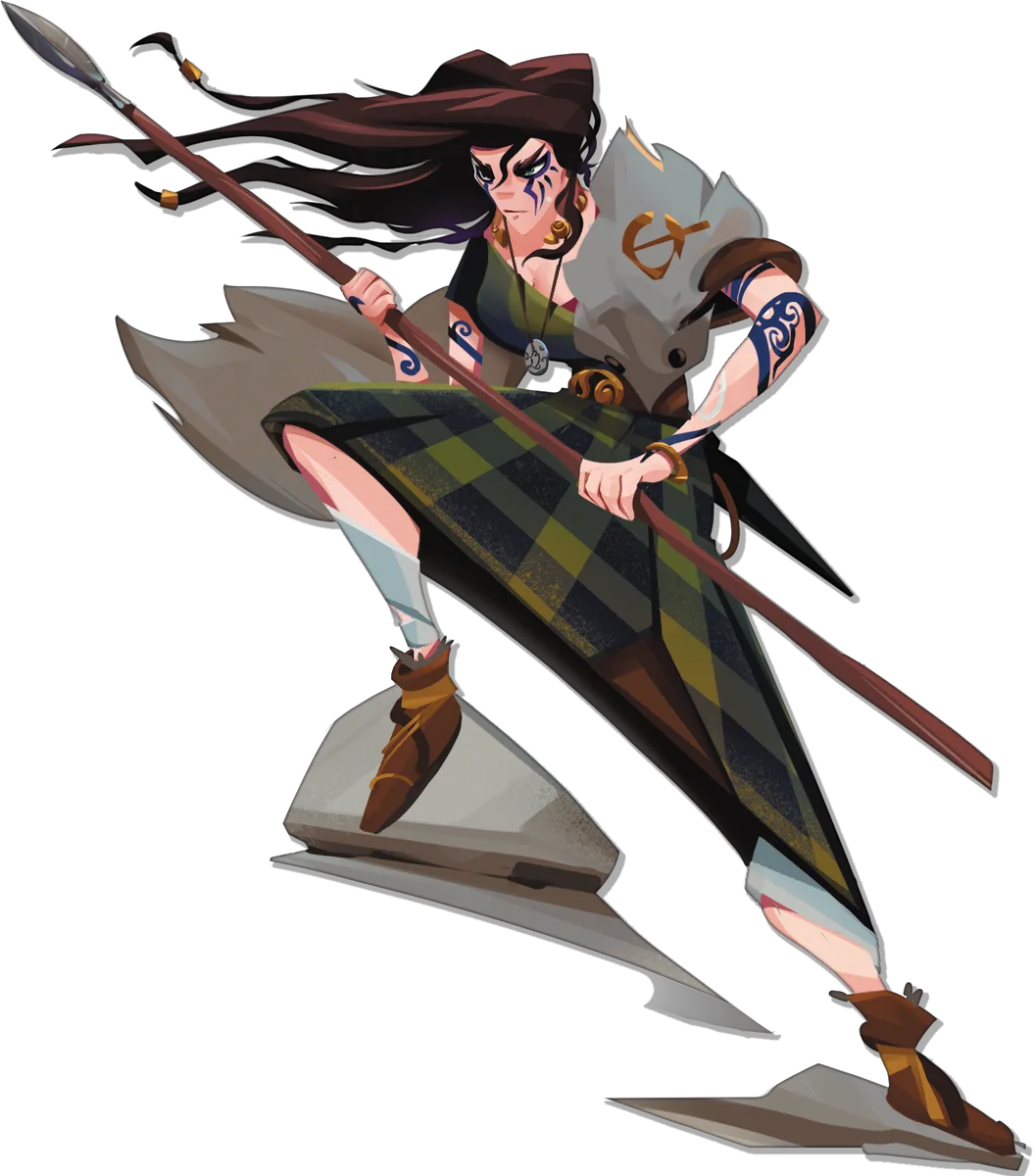
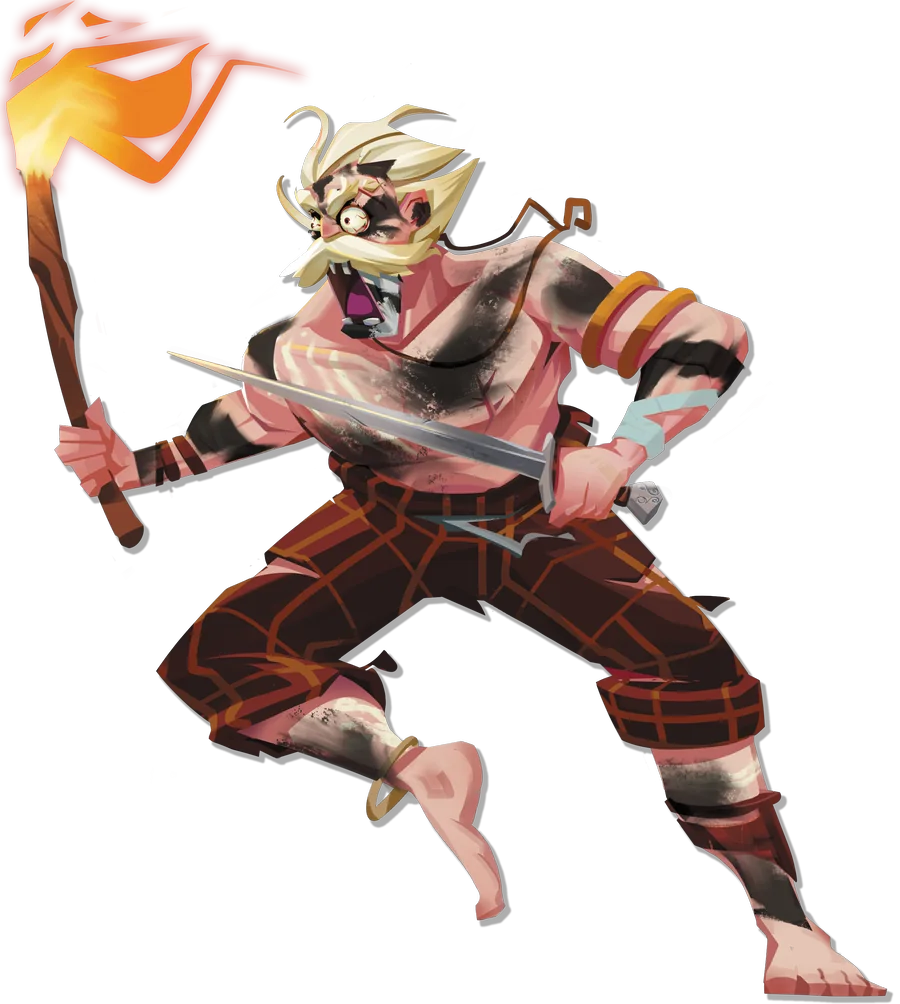
Niamh, the warrior

I’ll tell you before we start

A five-player game lasts two and a half hours. It’s a long game, and whoever sits down needs to know now, not halfway through the third turn.

Niamh, the warrior

The playing time isn’t a range: it’s a multiplication. Thirty minutes per player means an hour with two and two and a half hours with five, and the game always ends at the same point, the twelfth turn, however many of you are sitting down. More players don’t make the game longer: they make each trip around the table longer.

On age we write 14+ and nothing else, because that’s what’s on the box. It isn’t an estimate of how hard the game is: under fourteen, a game is classed as a toy and needs different testing. If someone younger plays at your table, we won’t be the ones telling you no.

Setting

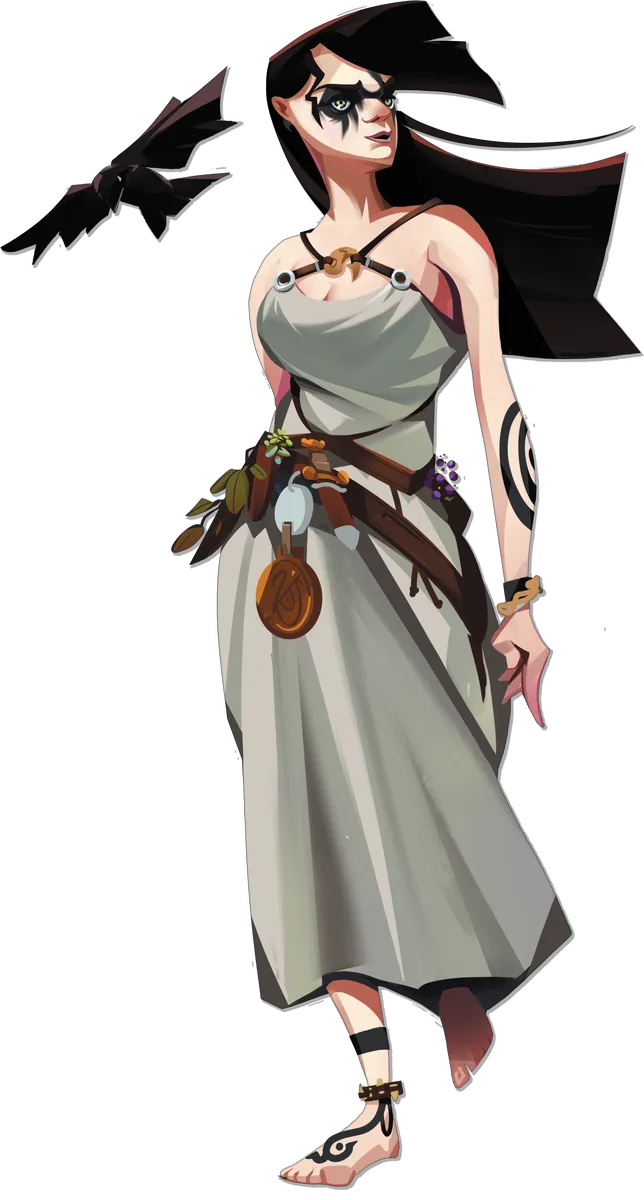
Lindsay, the mystic

Britain, 54 BC

I read the signs: Rome is coming. But nobody here looks up — we’re too busy snatching things out of each other’s hands.

Lindsay, the mystic

The tribes of Britain fight among themselves, ignoring the looming threat of Rome, which within a few decades will change their lives forever. In this corner of the world, five kings compete for fame and fortune.

At the table you are one of those five. You rule a village, seven tribesmen and a handful of leaders (craftsman, warrior, merchant, mystic), and over twelve turns you must gather more Fame than the other four. Fame comes from developing, trading, raiding and winning battles: four paths, and none that doesn’t go through the others.

There are no quiet turns. If someone raids or attacks you, you must respond even if you have already passed; and as long as you are in the game you can step into a quarrel between two others, taking whichever side you like. The Fame track is public from start to finish: whoever is winning is always in plain sight, with a target on their back.

Take a closer look

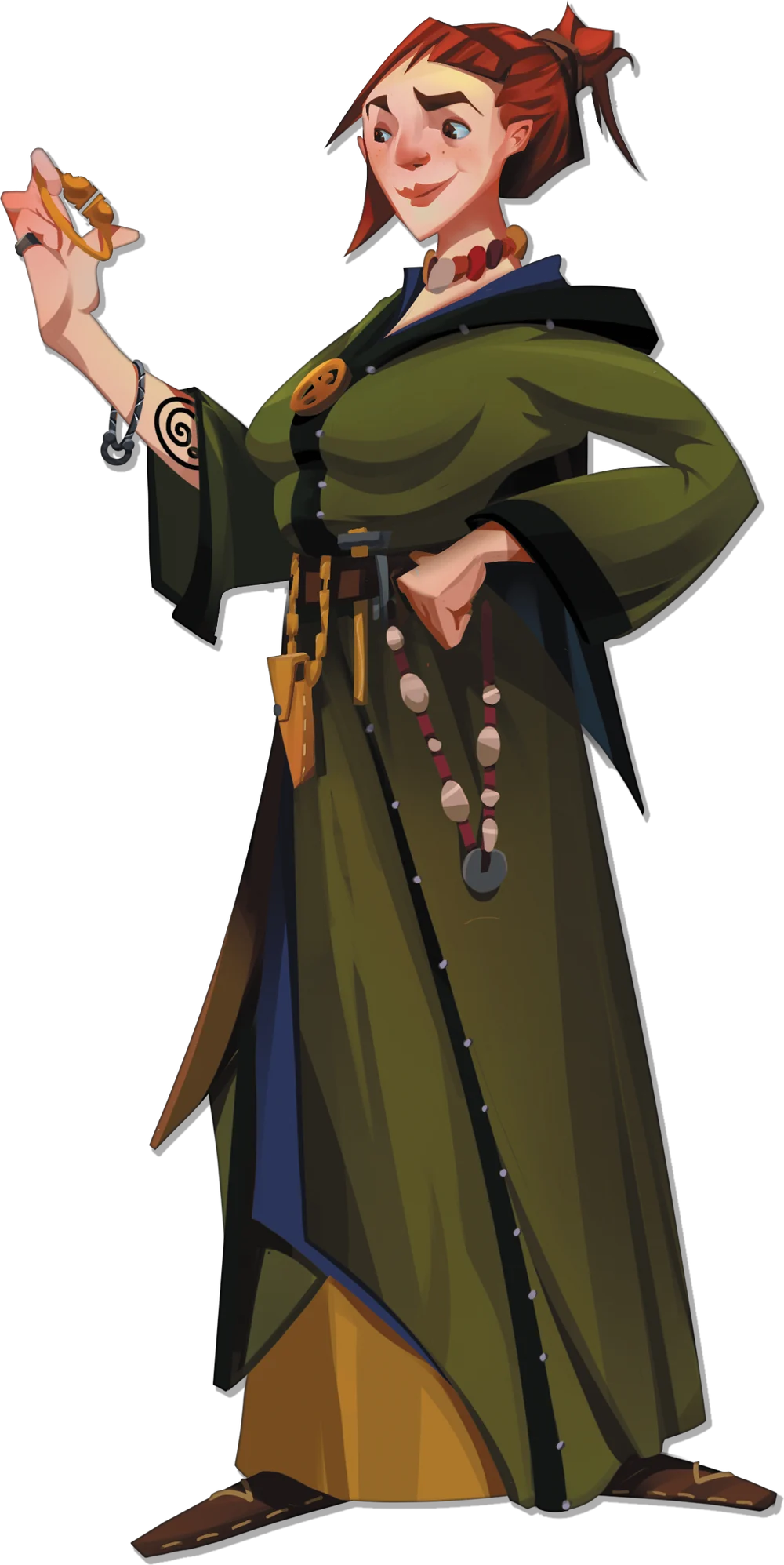
Ygerna, the craftswoman

I made the pieces

Boards, meeples, tiles: it’s all real wood and cardboard, and you can feel it before you even see it.

Ygerna, the craftswoman

  • Everything that’s inside
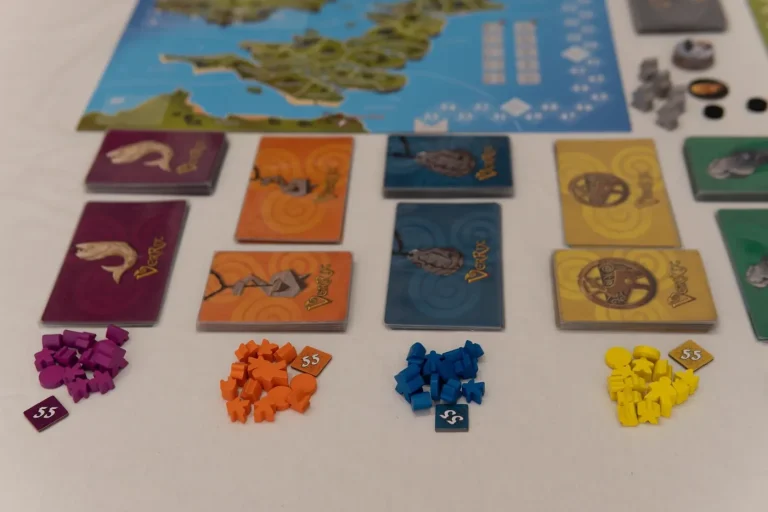
  • The five tribes
  • The open box
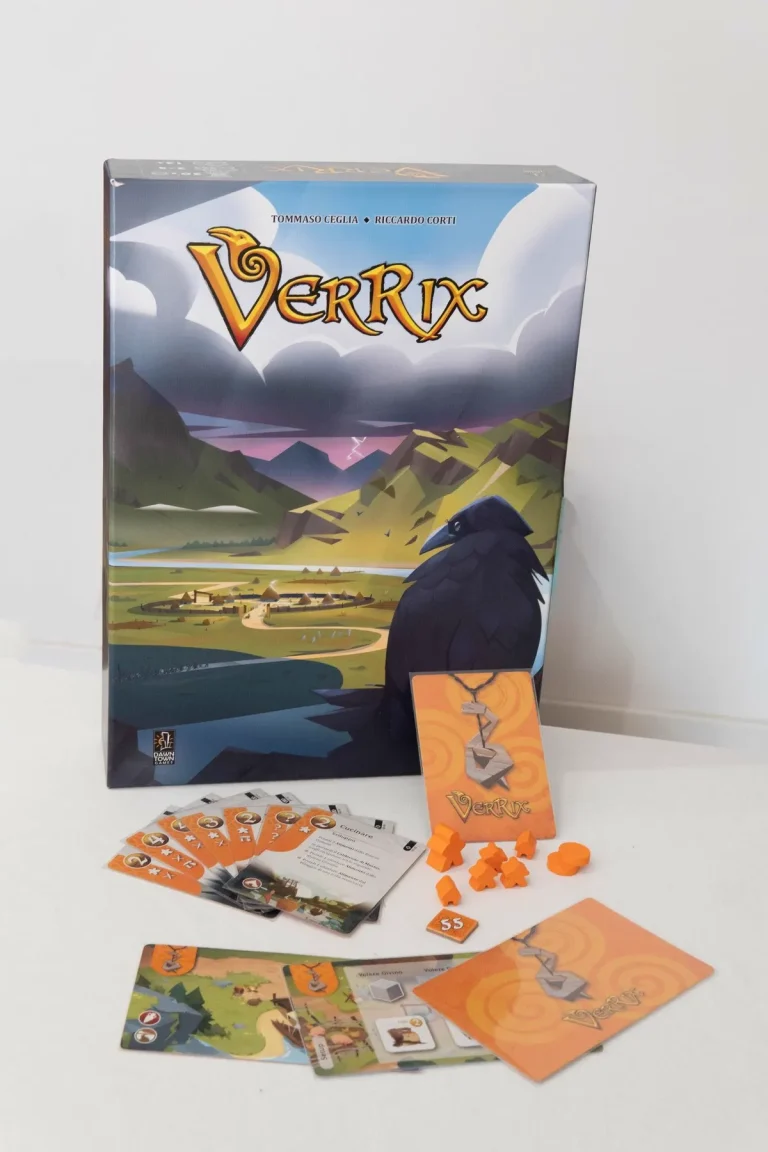
  • The Orange tribe

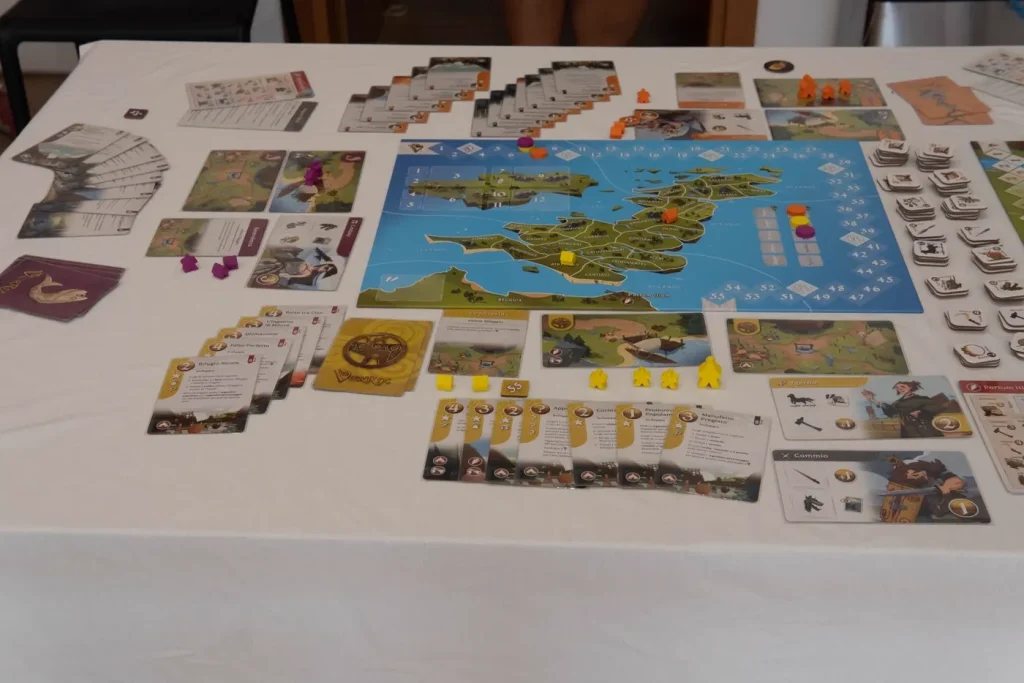
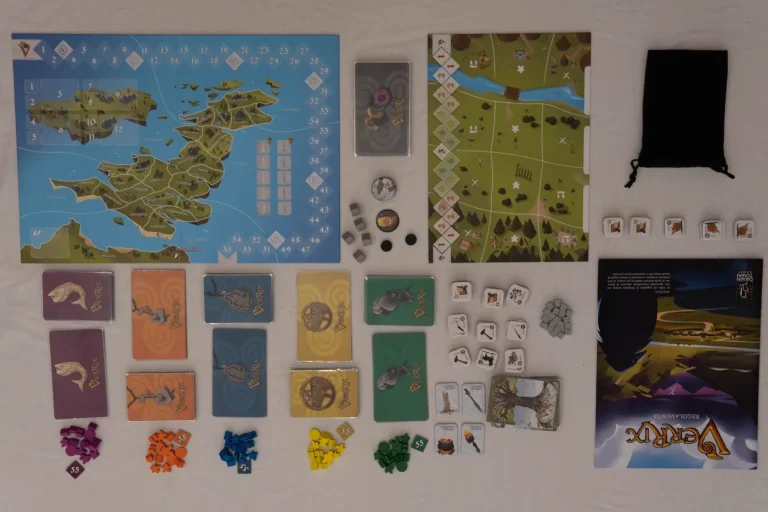
On the table there are two boards, the map of Britain and the Battle Board, and around them everything else: seventy Action Cards in five colours, the Goods tiles, the tribesman meeples and Village tokens, the Divine Will cubes and the bag of Mórrígan tokens, which you draw from with your eyes closed.

The photos show real copies, not renders: what you see here is what arrives at your home, with the same colours and the same thickness of cardboard.

How to play

Artghal, the raider

Passing won’t get you out of it

If I come for your goods you have to answer me anyway, even if your turn was over. I’m only warning you once.

Artghal, the raider

  1. Twelve turns, with a fixed rhythm

    Two Month Turns and then a Festival, four times over. The four Festival tiles are face up from the start: you know the goals in advance and plan for them.

  2. The gods charge for Events

    Every Month Turn you pay three Divine Will cubes and draw an Event Card. Some take effect immediately and are read out loud, others are kept face down and played when it suits you, but only one at a time.

  3. The cards, and the strength to play them

    Every action needs an Action Card, and each card can be played only once per turn. To play it, you commit tribesmen and leaders up to the STRENGTH it requires: a leader worth 3 counts as three tribesmen, and you choose the combination.

  4. Development, Trade, Raid

    You develop at your own village, and what you produce stays on display until the Cleanup Phase. You trade far away, and whoever is on the receiving end of a trade must accept it. You raid elsewhere, and the outcome is a contest of STRENGTH in which the defender draws a Mórrígan token: the goddess sides with whoever is under attack.

  5. Battle rewards risk

    Three Rounds, a disc that moves towards whoever is winning, and the other players who can side with one or the other. Each card states which classes fight in that Round: the right card isn’t the strongest one, it’s the one that sends your units into the field and leaves theirs out.

  6. Passing is a move

    The first to pass takes 1 Victory Point and will be first player in the next turn. Dropping out early helps your place in the Playing Order and costs you actions: it’s one of the decisions that really matter at the table.

They don’t all play the same way

Lindsay, the mystic

Nobody starts out stronger than anyone else

We start out different, not unequal. Then each of us learns what we need, and halfway through the game we’re no longer who we were at the start.

Lindsay, the mystic

Verrix is asymmetric, with five evenly balanced tribes: no side has the advantage, but no side is the same as another. Each tribe has a main trait (blue battle, orange raiding, purple mysticism, green trade, yellow craftsmanship) and fourteen Action Cards of its own: nine Basic and five Special. Some are rare, and only one player owns them for the whole game.

But the differences aren’t set in stone. With the Learning action, a tribe adds a Special Action Card to its deck and can play it straight away: every tribe can evolve by learning the actions that come naturally to the others. The merchant can learn to fight and the warrior to negotiate, only for them it costs a turn, and for the other it doesn’t.

It means the table changes shape depending on who sits at it, and halfway through the game nobody is playing the way they started. There’s no strong tribe: there’s the one that resembles how you play, and the one you decide to become.

The rulebook

Niamh, the warrior

Twenty-eight pages, then you decide

Read them before you buy. Whoever comes to the table without knowing how to fight doesn’t stay at the table for long.

Niamh, the warrior

Verrix comes in two separate editions, Italian and English: they aren’t two rulebooks in the same box — you choose the language when you buy.

Italian rulebookEnglish rulebook

What’s in the box

Ygerna, the craftswoman

I filled it myself, piece by piece

Seventy Action Cards, the goddess’s tokens in their bag, and everything else you’ll find below.

Ygerna, the craftswoman

  • 1 Kings’ Board, the map
  • 1 Battle Board
  • 70 Action Cards — 14 per tribe, in five colours
  • 20 Event Cards
  • 7 Common Leader Cards
  • 67 Goods tiles
  • 7 Mórrígan tokens, with their bag
  • 20 Divine Will cubes
  • 35 tribesman meeples
  • 15 Village tokens
  • 4 Trophy tiles
  • 4 Festival tiles
  • 1 Kings’ Ring tile, plus the Victory Points and Playing Order discs

Plus the Village, Travel, Setup, Ability, Leader, Portum Itium and Rules Reference Cards: five per colour.

Things you don’t notice straight away

Lindsay, the mystic

Look more closely at the colours on the table

Something’s missing, and it’s not an oversight: it’s the part of the world that hasn’t arrived yet.

Lindsay, the mystic

There’s no red, and that’s no accident

Red is the colour of the Romans: the soldiers’ tunics, the officers’ crimson cloaks. In Verrix the Romans haven’t landed yet, so the colour isn’t there. Five tribes, five colours, and an absence that tells the whole story of the setting.

The goddess sides with the defender

The Mórrígan token is drawn by the defender, not the attacker, and they draw it even if they haven’t deployed anyone. On a tie, the raid fails. In this game, chance protects whoever is under attack.

There’s no money, and there’s no change

To buy a Sword worth 5 you have to sell goods worth at least 5. If you hand over 6, that extra point is gone. One line of the rulebook that tells you at a stroke what kind of game this is.

The four Treasures are real

The Cauldron of Murias, the Spear of Gorias, the Sword of Findias, the Stone of Falias: they are the four treasures of the Túatha Dé Danann, from real Irish mythology. The same tradition the Mórrígan comes from.

Every tribe has a trade and an amulet

Blue battle, orange raiding, purple mysticism, green trade, yellow craftsmanship. And on the back of the cards, an amulet for each: a serpent, a carved stone, a torc with a stag, a blade, a fish bone.

Fame never resets

The track starts at 3, never drops below 1, and doesn’t stop at 55: you start again from 1, taking the tile with you. There’s no final scoring: who is winning is clear at every moment of the game.

How heavy, how big

  • 1.36 kgper box
  • 31 × 23 × 6 cmdimensions
  • €6within Italy, up to 3 kg
Ygerna, the craftswoman

A kilo and a half, and a whole table

Under your arm it weighs nothing. Then you open it, and there’s no room left on the table for anything else.

Ygerna, the craftswoman

Designed by Tommaso Ceglia and Riccardo Corti. Art direction by Alfonso Bonfanti. Photos by Elena Zaretti.