
The cat is a piece, not a logo
The Siamese cat that turns up in all the illustrations isn’t just the mascot: at the table she’s the Action Indicator, made of wood, and you move her every turn to show which line you’ve chosen.
In someone else’s queuethere’s always room.
Run a street food stall in Fukuoka’s nightlife: cook the dishes, serve the customers, keep it clean. And in extreme cases, send an annoying customer to the stall next door.

Twelve turns, fifteen minutes each. The length of a real dinner, not a campaign.
the chef at the next stall
Twelve turns, fifteen minutes per player: with two you’re done in half an hour, with four in an hour. It’s the shortest game in our catalogue and the quickest to explain — the rules fit in sixteen pages, and you learn your first game by playing it.
On age we recommend 14+, but at the table Yatai works very well for younger players too.

People come here to eat and stay to talk. Then again, while you’re talking, I’ll fill your line with people you don’t want.
the cook at the stall opposite
Yatai are the street food stalls of Fukuoka: they open in the evening and close late at night, and the rulebook describes them for what they really are — “the best places to make friends”.
At the table you put on the chef’s apron. You cook ramen, gyoza, ebi tempura and yakitori, refill the Fridge, serve the Customers waiting in line and keep an eye on their Reviews: Service, Value, Atmosphere and Cleanliness. Every queue has limited space — if the Fridge is full you can’t refill it, if the Recycle Box overflows you’re in trouble — and that’s what the whole game is about: keeping things moving as well as you can in the little space you have.
There are a few dirty tricks. You draw new Customers from the bag, and you can put them in the queue at your stall or at an opponent’s. A Tourist can even take the place of a Customer at another stall. Nobody ever attacks you, and yet by the end of the evening someone will have something to complain about because of you.

These are the original drawings, the ones that went to the printer. Look at the wood on the board and the flowers on the branch: at the table you hold them in your hands, but here you see them better than that.
the old hand of the alley
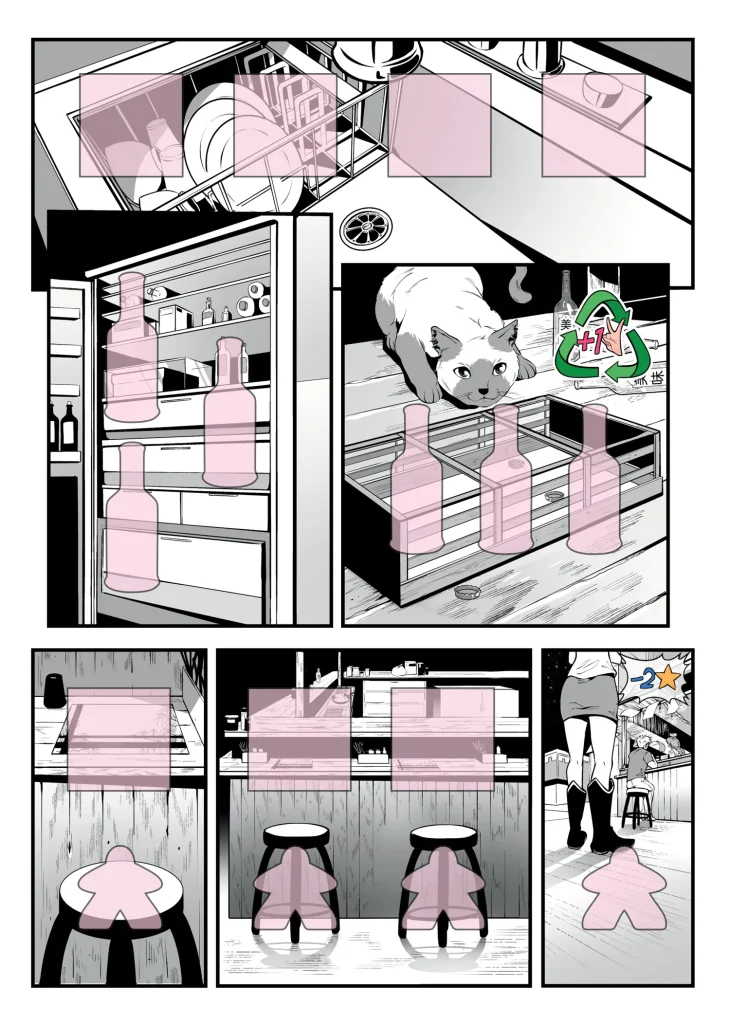
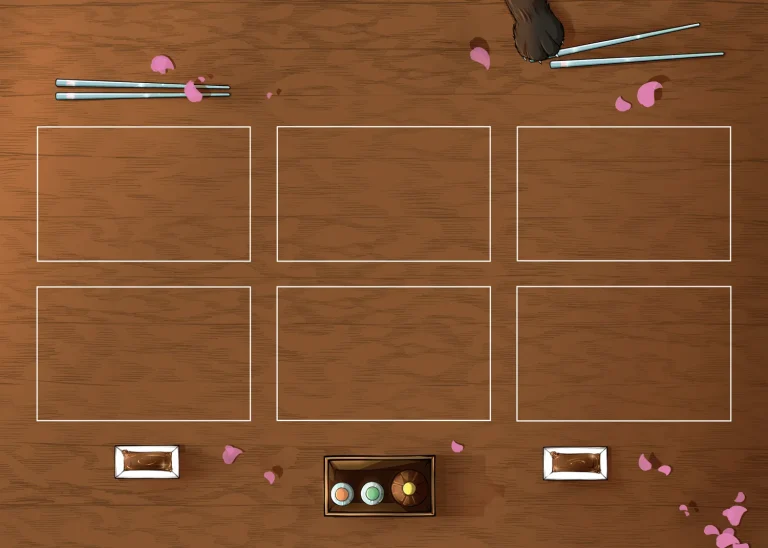
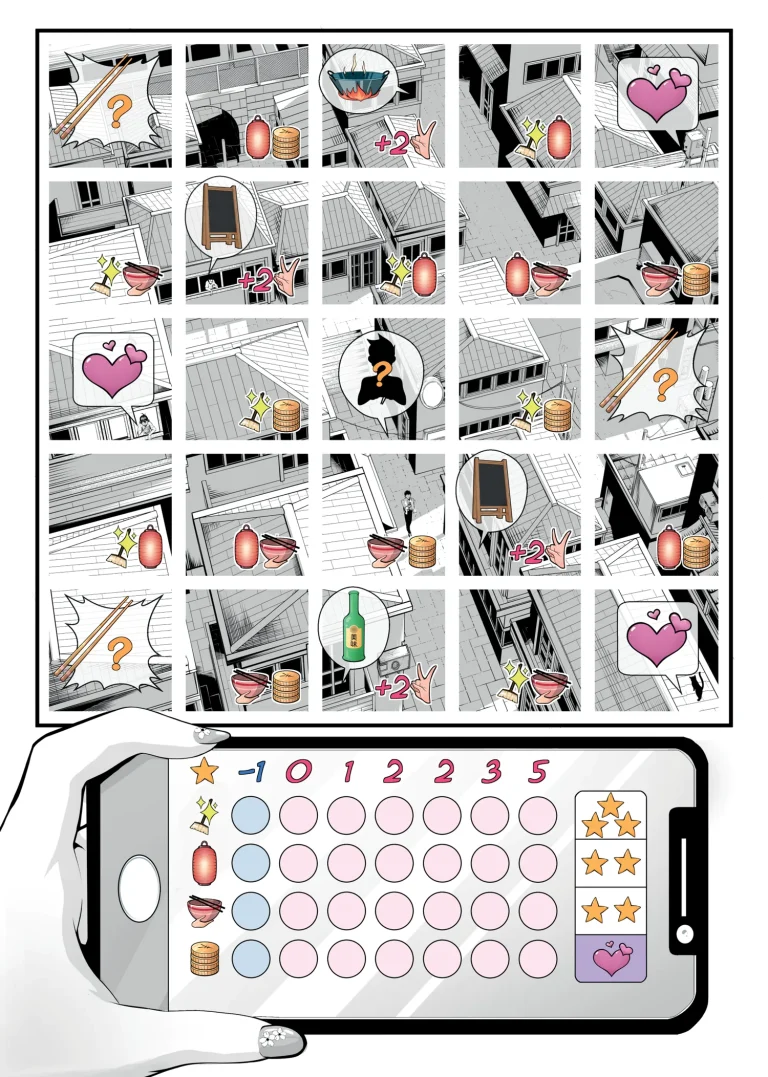
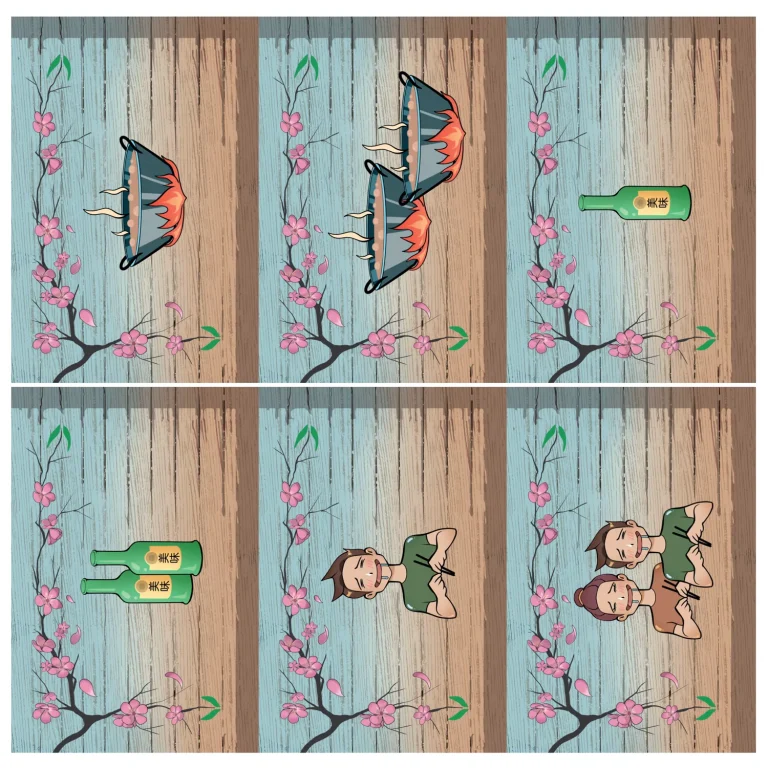
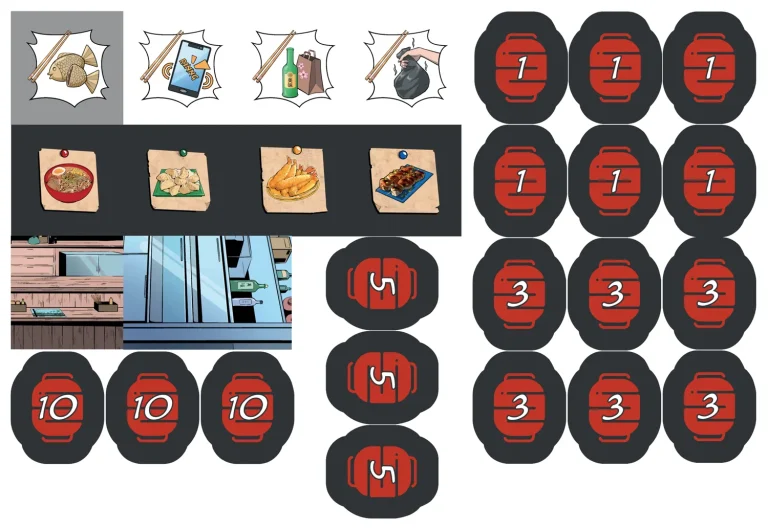
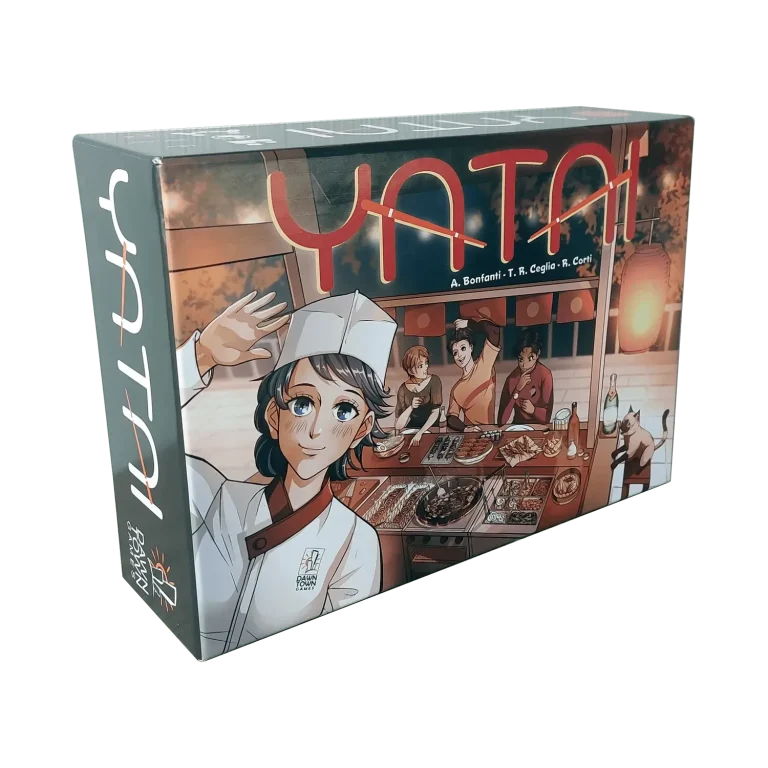
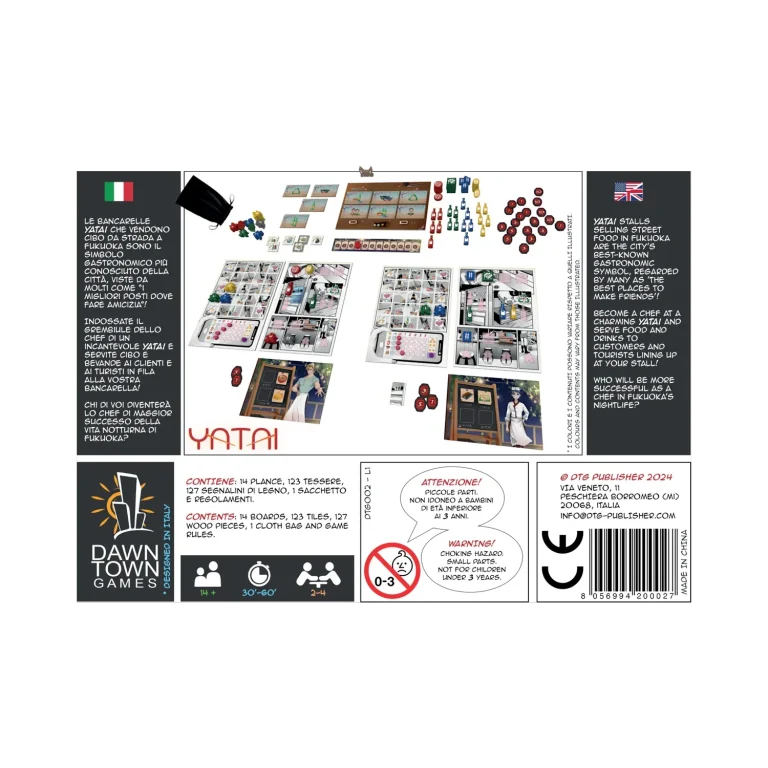
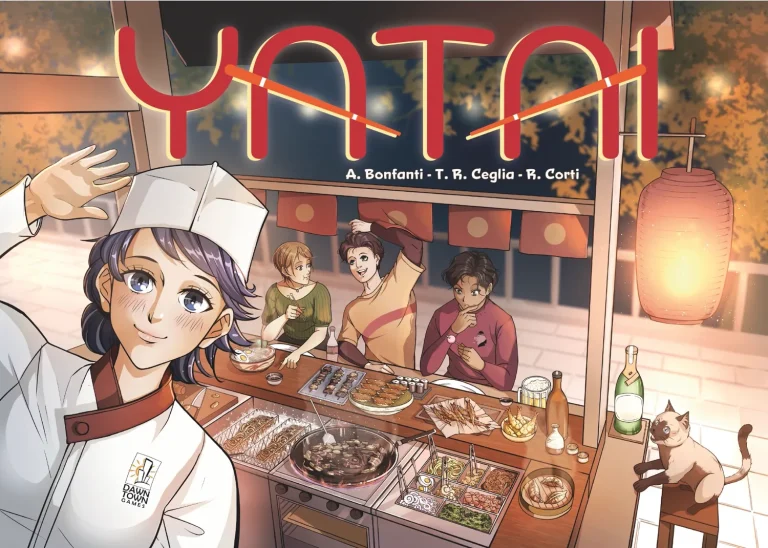
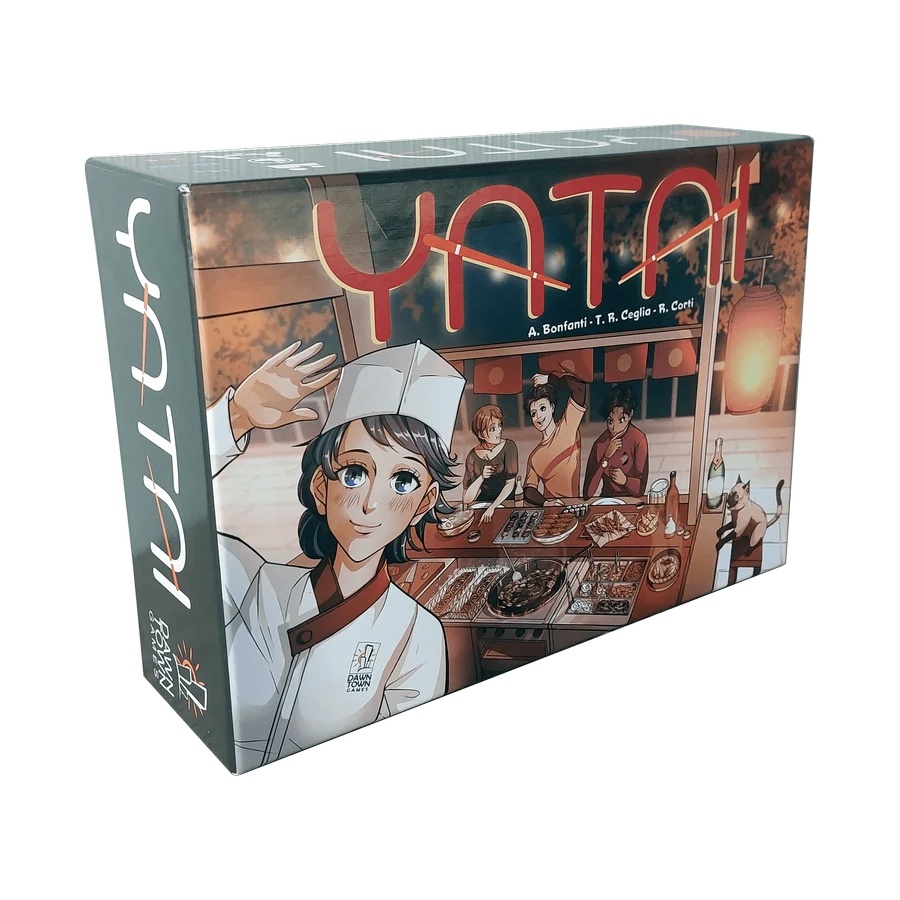
What you see here is the original artwork, the same files that went to print: the boards, the Action tiles, one player’s pieces, the front and back of the box. It’s the game as it was drawn!

Fridge full, no refills. Sink full, you’re in trouble. You don’t lose because someone attacks you: you lose because nothing else fits.
the rival with the braid
Each turn you check your queue, choose an Action tile and slide it into the grid, then carry out the actions in the row or column you chose, in whatever order you like.
If a Customer reaches the end of the line without being served, you lose 2 Reviews. You can save yourself by offering them a drink or a Taiyaki Sweet — but the drink ends up in the Recycle Box, and that has limited space too.
New Customers and Tourists, Cook Dishes, Refill Beverages, Serve, Recycle Bottles. Every action must be completed in full: if it doesn’t fit, you skip it. The whole game is about keeping the right spaces free at the right time.
When you draw Customers and Tourists from the bag, you decide where to put them: in your queue or in an opponent’s. A Tourist can even replace a Customer already waiting at someone else’s stall.
Two Improvement tokens start out covering parts of your board. Freeing them up increases your capacity: it’s how your stall grows, and you pay for it in actions spent not serving anyone.
Dirty Dishes in the sink by colour, served Customers on the bonus grid, the four markers on the Review track — which can go below zero — and the points on the back of the Special Action tokens you didn’t use.
Go ahead, slide your tile in. The one you push out at the other end is mine, and I’ll take my turn with it.
the chef at the next stall
It’s the heart of Yatai, and it’s one move that does two things. The six Action tiles sit in a grid of two rows by three columns. On your turn you take one of the four tiles off the board and slide it into a column from the top or into a row from the left: you carry out the actions of that line, and the tile pushed out at the other end becomes available to whoever plays after you.
It means that every time you choose what to do, you’re also deciding what to leave for your neighbour, and rearranging the lines they’ll find on their turn. Try it: pick a tile, press an arrow and watch where the others end up.
These are the game’s ten real tiles, with the artwork from the card: five actions, some in a double version. Hover over a tile to read its name. At the table the grid sits on a wooden board and the indicator is a cat.
You can read it in a quarter of an hour, and both languages are in the box. Nobody has to wait for the translation.
the cook at the stall opposite
A single box, with both rulebooks inside: Italian and English.
Forty Customer meeples, five Tourists, the End Game lantern and the wooden cat. The cat is the piece everyone wants to hold.
the old hand of the alley
Plus the two rulebooks, Italian and English, in the same box.
There are things on the table you only notice by your third game. I’ll tell you one now so you get there sooner.
the rival with the braid
The Siamese cat that turns up in all the illustrations isn’t just the mascot: at the table she’s the Action Indicator, made of wood, and you move her every turn to show which line you’ve chosen.
There’s a branch of cherry blossom on the board, and the rulebook uses it as a reminder: “Check the leaves at the end of the cherry blossom branch!” It helps you remember which way to slide tiles in without rereading the rules.
They aren’t generic figures: there’s the koureisha, the senior citizen; the jugyoin, the employee; the yankee, the delinquent; the gakusei, the student; and the kankokyaku, the tourist. Five kinds of people you really do meet in Fukuoka, at night, in front of a stall.
The track has negative values. You can end the evening with your reputation in the red, and that’s not a figure of speech: those points are subtracted.
The Special Action tokens you haven’t played are worth points on the back. Holding on to them is a legitimate strategy, and deciding when to burn one is half the game.
That’s how the rulebook describes real yatai. Then it hands you a bag of customers and lets you decide which queue to put them in — and it won’t necessarily be yours.
It fits in a bag. Open, it takes over the table the way my stall takes over the alley.
the chef at the next stall
Designed by Alfonso Bonfanti, Tommaso Ceglia and Riccardo Corti.